
In supply chain management, keeping a safety stock buffer is standard practice to prevent stockouts during demand spikes. But with modern analytical methods, it's worth asking: how justified is that traditional approach?
How Safety Stock Works (and Where It Fails)
At first glance, the traditional approach seems reasonable: forecast the mean scenario, then add a fixed or calculated safety buffer to guard against demand spikes.
However, the classic concept relies on the assumption of a normal (Gaussian) distribution, right where that assumption breaks down most:
- Asymmetry and Heavy Tails: Demand spikes in retail and manufacturing often feature a heavy right tail, meaning extreme spikes occur far more frequently than predicted by a standard normal curve.
- Operational Complexity of Dual Modeling: The traditional workflow requires forecasting base demand first, then separately modeling variance and risk. This introduces unnecessary friction and system boundaries.
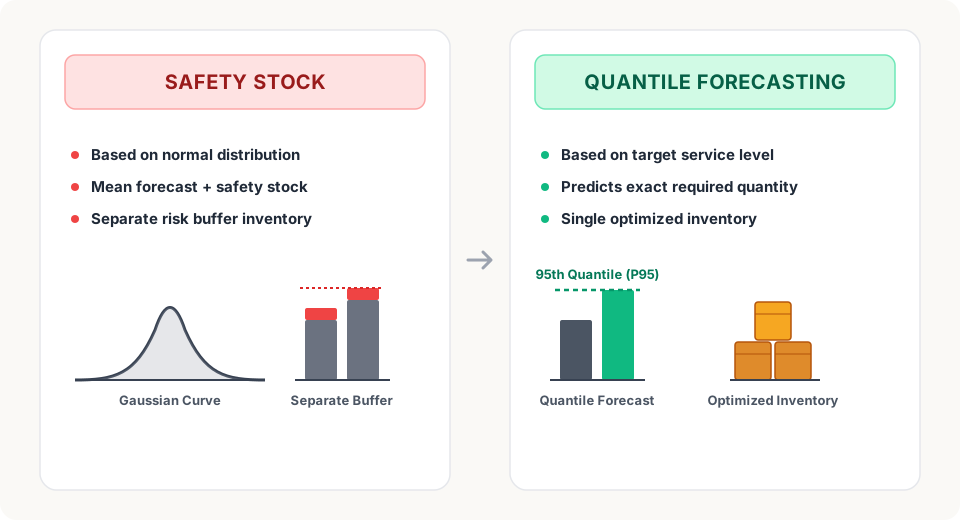
Comparison of traditional Safety Stock (separate buffer based on Gaussian curves) vs. Quantile Forecasting (single optimized inventory aligned with target service level).
The Alternative: Quantile Forecasting
It is far more natural to start with the core business question: What is our target Service Level?
Of course, a service level cannot be 100%, as that would require infinite inventory. Therefore, holding and capital costs must be accurately weighed against stockout risk.
Why Quantile Regression Changes the Game
Once a target service level is set, traditional safety stock becomes redundant. Quantile regression directly answers: "What stock level supports our target service level?". If the optimal service level is 95%, we estimate the 95th quantile (P95) of future demand distribution and stock directly to that level.
A Simple Recipe for Inventory Optimization
- Define target service level per category and SKU.
- Use forecasts that honor that service level (estimating required quantiles instead of plain averages).
- Set stock levels directly from quantile estimates without separate static buffers.
- Inventory stops being a passive "airbag" and becomes the result of measurable financial optimization.
How Inventarko Enables This in Practice
Historically, quantile methods were reserved for enterprise giants with dedicated data science teams and expensive software.
Inventarko brings advanced quantile modeling to SMBs, bakeries, and distributors without needing massive capital or internal data science teams.
This eliminates guesswork around fixed percentages, giving procurement a clear mathematical foundation for every order.
Read the companion article on measuring forecast costs: How Much Do Forecasts Really Cost Us? Why Accuracy Alone Is Not Enough